 |
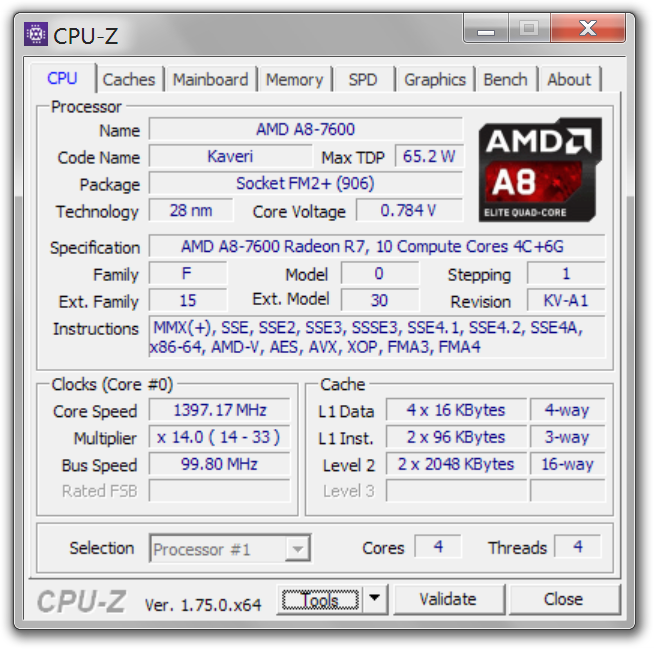
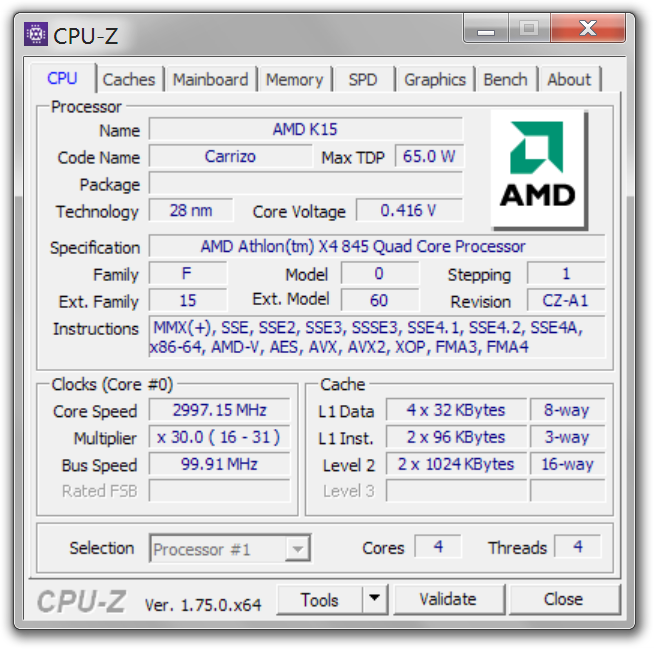
| Our contenders! |
| 
|
| A8-7600 |
Athlon x4 845 |
|
Here we have the two most important CPUs which we are pitting against each other.
The Steamroller-powered AMD A8-7600 and the newly released, Excavator-powered, AMD Athlon™ x4 845.
Neither of these are powerful CPUs. They have nothing particularly going for them against the competition - except, maybe, a marginally favorable price/performance ratio. Nothing, except for the fact that the performance of one will tell us about AMD's future prospects in regards to their upcoming Zen architecture. And that same CPU can be a nice drop-in upgrade for existing FM2+ systems.
|
All results here are posted in relative terms, you can get the exact results here.
All instructions you give to a CPU are not equal - if they were, we'd get a nice simple performance number that we'd multiply against the clockspeed to know what to expect. No, instead we have many types of instructions, many types of instruction mixes, and many variations in performance based upon those types of instructions.
As such, we will look at integer, floating point, and memory performance separately. Then we will be looking at single full-core performance as a whole... followed by a quick frequency scaling examination.
| Integer |
|
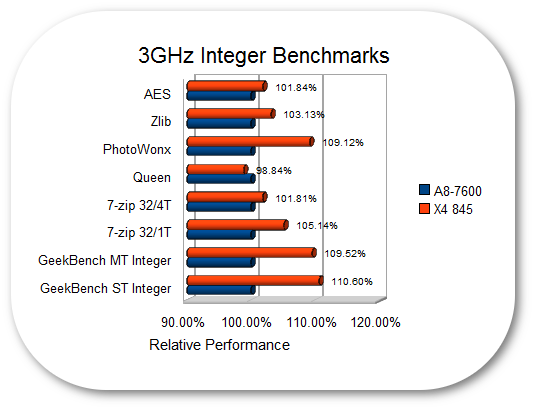
Integer performance is much more important than popular benchmarks lead you to believe. Almost every system function and performance optimization not relying on specialized instructions (and even many of those) are bound to integer performance.
However, even here, we have many different types of instructions, and not all are improved with Carrizo. The reduced L2 capacity appears to have hurt its SIMD-friendly Queen score, and multi-threaded results show a clear penalty.
|
| Memory |

|
These days memory performance often has minimal impact on CPU performance. Memory is plenty fast enough, and CPUs typically have great cache systems to accommodate slower memory.
Still, we see some signs that memory performance has improved, for an unknown reason, with Carrizo. Geekbench consistently gave the Carrizo a much higher score, but AIDA64 shows only a modest write improvement.
|
| Floating Point |

|
These days the focus is all on the mighty floating point unit (FPU) in modern processors. Carrizo remains impeded by a shared FPU per module (every two cores), but we still see some decent improvement here.
The benchmarks preceded by "FPU" are from AIDA64 and don't represent a broad range of instructions, so we are seeing very specific improvements, and areas AMD effectively ignored. Cinebench results are in their own section...
|
| Cinebench - Mixed Compute, FPU-heavy |
|
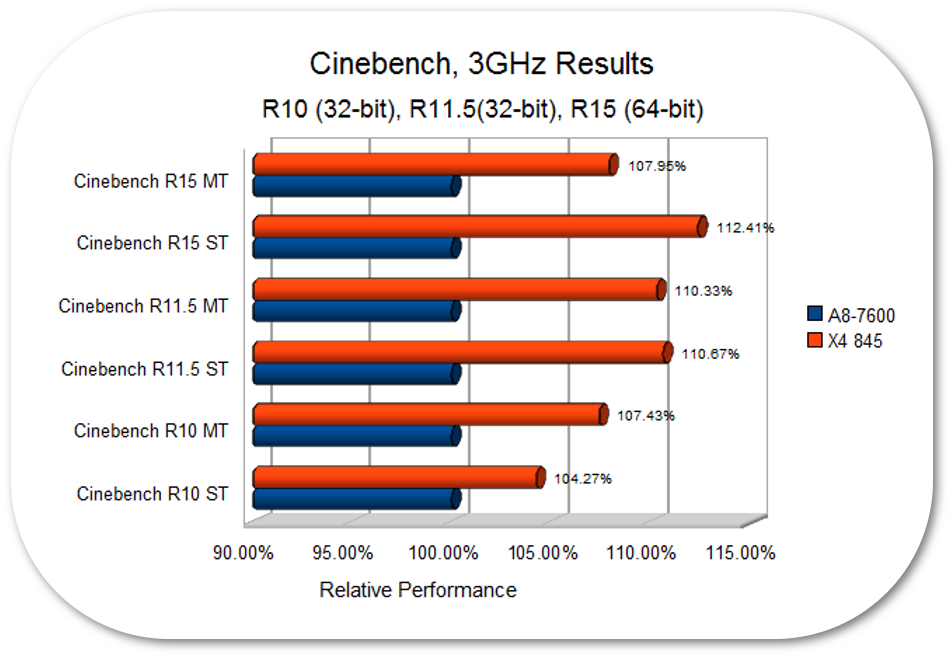
The ever-popular Cinebench deserves its own section. This benchmark represents a real-world program's performance - and here, we are using three different versions of it... and getting three different results!
It appears that R11.5 has the most consistent improvement with the Carrizo (x4 845), but the single largest gain is with R15's 12.41%. I saw in forums claims that R15 wasn't showing as much improvement, but I'm not seeing that - and I did this test three times!
|
| Single-Thread |
|
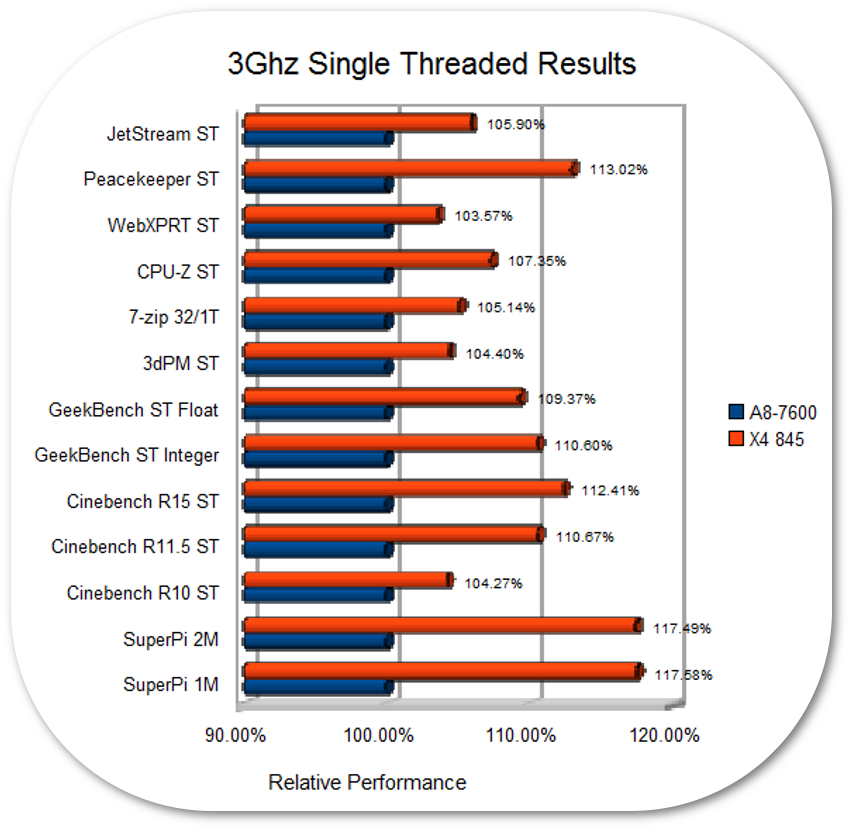
When you use a personal computer, the most important metric for its performance is related to how well one thread can execute.
Here, we see the meat of what we really want to see - meaningful improvements!
The worst result is 3.57% faster than Kaveri(A8-7600), the best is a whopping 17.49% faster!
The end result is an average 9.37% improvement, which is much more respectable than the 7.64% result from a blind averaging of all the results.
|
Okay, so far all of these results have been obtained at 3Ghz. But BOTH of these CPUs run at up to 3.8Ghz... and frequency scaling isn't always perfectly linear.
Sometimes going up 25% in frequency gives you 25% improvement. Sometimes it brings you 5%. And, sometimes, you will get just a little more than you think you should due to certain time-based latencies intermixing the clock-based latencies and a certain synergy occuring that gives you a little extra something something.
When we compare the 3GHz results to the full-speed results, we shouldn't see much change in the CPUs' relative performance... but we do.
| Stock Results |

|
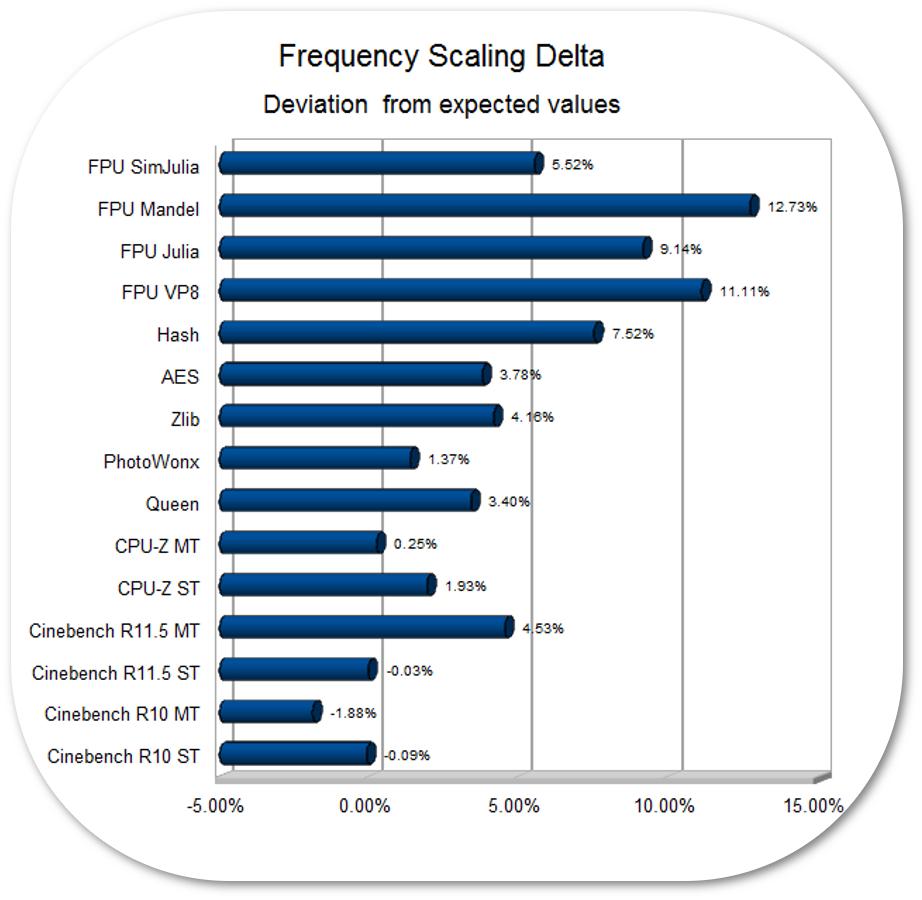
It may not be immediately apparent from the chart on the left, but some of these results are much higher for Carrizo than they should be, so I made another chart (on the right) so you can see the difference from expectations.
Part of this is because Carrizo, for whatever reason, maintains its clock speeds impeccably - it's pretty much always running at 3.8Ghz, whereas Kaveri maxes around 3.7, and often drops momentarily to lower speeds.
This behavior, as has been told to me, is not as expected and may be a fluke on my system - but nothing I do changes it. The two should clock in similar fashion. But that's not what I'm seeing at all.
Stock-to-stock, the x4 845 is demonstrating 10.78% higher overall performance in this random selection of benchmarks - a very nice improvement, indeed.
|
|
|
So, all that's good... but what about Carrizo vs Sandy Bridge ?
|
